Ramesses II: The Great Pharaoh and Where to See Him in Cairo
He ruled Egypt for 66 years, turned a stalemate into a legend and signed one of the oldest surviving peace treaties. The real Ramesses II, and the places in Cairo where you can still stand in front of him.
You meet Ramesses II in Cairo before you've seen a single temple. Cairo's main railway station is called Ramses Station, and the square outside it is Ramses Square. The 11-metre granite giant that greets visitors at the Grand Egyptian Museum is him too. Across town, in a darkened hall in Fustat, you can stand a metre away from his actual face. He ruled for 66 years, outlived a dozen heirs, signed one of the oldest surviving peace treaties and covered Egypt in his own name. He was also, by modern standards, a shameless self-promoter. This is his story, and how to see what's left of him in and around Cairo.
Ramesses II at a glance
| Fact | Detail |
|---|---|
| Reign | 1279–1213 BC (about 66 years), 19th Dynasty, New Kingdom |
| Born / died | c. 1303 BC / c. 1213 BC, aged about 90 |
| Parents | Pharaoh Seti I and Queen Tuya |
| Best-known wives | Nefertari, Isetnofret and the Hittite princess Maathorneferure |
| Children | Around 100 (estimates range from about 88 to 103) |
| Successor | Merenptah, his 13th son |
| Tomb | KV7, Valley of the Kings (Luxor) |
| Mummy today | National Museum of Egyptian Civilization (NMEC), Cairo |
| Other name | Ozymandias, the Greek form of his throne name Usermaatre |
A soldier's grandson becomes king
Ramesses wasn't born into an ancient royal line. His grandfather, Ramesses I, was an army officer from the eastern Nile Delta. The childless pharaoh Horemheb picked him as heir, and he founded the 19th Dynasty. His son Seti I made the young Ramesses prince regent and took him on military campaigns while he was still a teenager.
Ramesses came to the throne in 1279 BC, at about 25. He already knew what he wanted: to be remembered as the greatest king Egypt ever had. He spent the next 66 years working on that, with soldiers, stonemasons and an enormous amount of carved propaganda.
Kadesh: the battle he turned into a triumph
In the fifth year of his reign (c. 1274 BC), Ramesses marched north to take Kadesh, a fortified city on the Orontes River in today's Syria. It was held by the Hittites, the other superpower of the age, under King Muwatalli II.
It nearly ended in disaster. Two Bedouin who came into his camp posing as deserters told Ramesses the Hittite army was far away. In fact it was hidden behind the city. Hittite chariots smashed through one of his four divisions and surrounded his camp. Ramesses rallied his guard and held on until reinforcements arrived. The battle ended in a stalemate, and Egypt never took Kadesh.
You would never guess that from what he built afterwards. Ramesses had the battle carved as a personal victory on the walls of Abu Simbel, Luxor, Karnak, Abydos and his memorial temple, the Ramesseum. In the reliefs he charges the enemy almost alone. It's one of the first great PR campaigns in history, and it worked for 3,000 years.
The peace treaty you can still read
The war with the Hittites dragged on for another decade and a half. Then, in year 21 of his reign (c. 1259 BC), Ramesses and the new Hittite king, Hattusili III, did something remarkable: they signed a formal peace treaty. It is often called the oldest surviving peace treaty, and it is the earliest for which both sides' versions survive:
- The Egyptian version is carved in hieroglyphs on the walls of Karnak Temple in Luxor.
- The Hittite version, written in Akkadian cuneiform on clay tablets, was found in the Hittite capital, Hattusa. One tablet is in the Istanbul Archaeology Museums.
The treaty includes non-aggression, a mutual-defence pact and the return of refugees, with a clause saying they must not be punished. A replica hangs at the United Nations headquarters in New York. Thirteen years later the peace was sealed with a marriage: in year 34, Ramesses married Hattusili's daughter, who took the Egyptian name Maathorneferure.
Builder, and recycler, of monuments
No pharaoh built more, or put his name on more. His most famous projects:
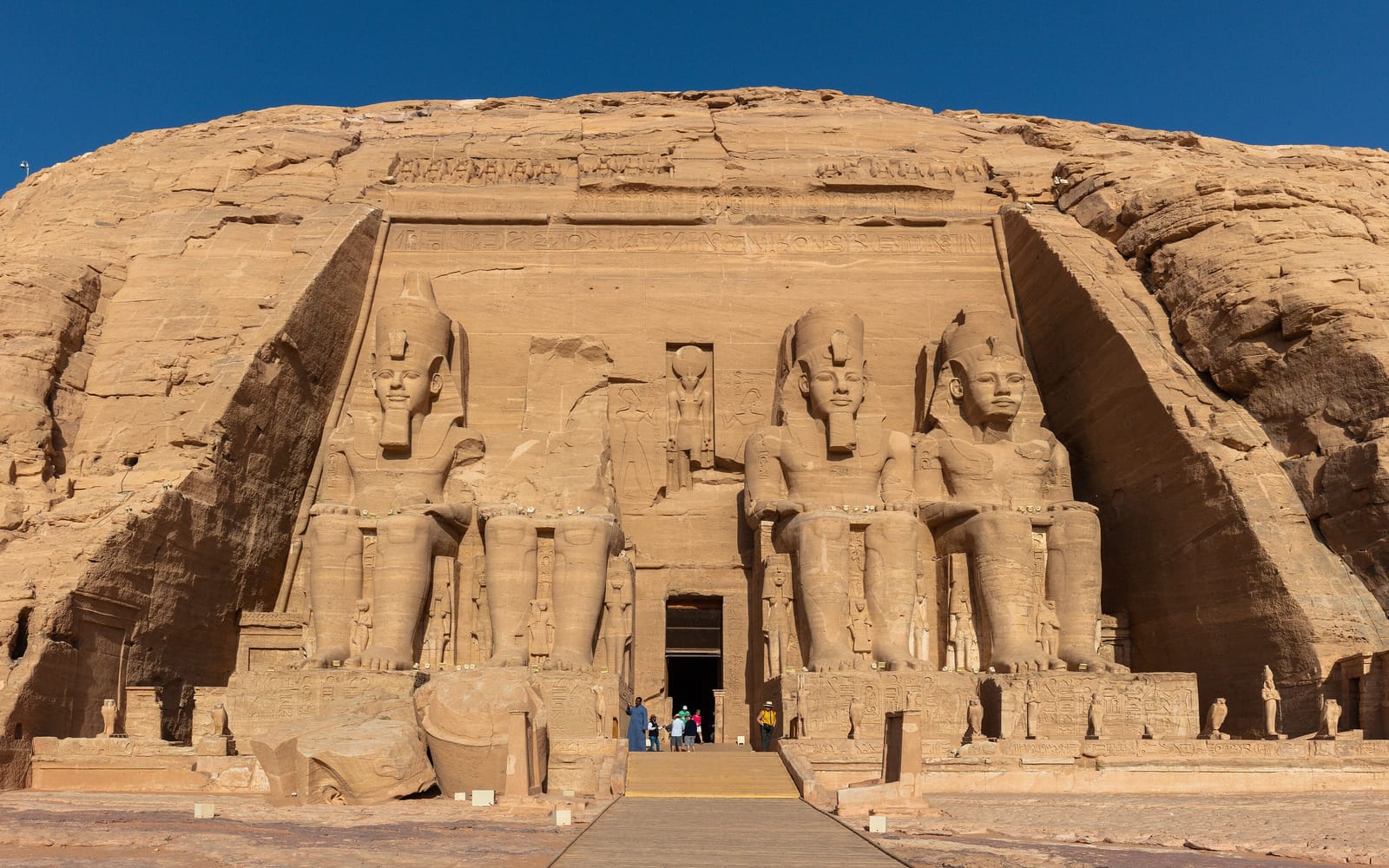
- Abu Simbel, in Nubia, near today's border with Sudan. Two temples are cut into the cliff. The Great Temple's façade has four seated colossi of Ramesses, each about 20 metres tall (that's the photo at the top of this page). The Small Temple is dedicated to the goddess Hathor and to his wife Nefertari.
- Pi-Ramesses, a new capital in the eastern Delta, near the modern village of Qantir.
- The Ramesseum, his memorial temple on the west bank at Luxor.
- Luxor Temple: he added the great entrance pylon and a pair of obelisks. One of them has stood on the Place de la Concorde in Paris since 1836.
- Karnak: he completed and decorated the Great Hypostyle Hall, the forest of 134 columns his father had begun.
- Abydos: his own temple next to his father's, which also carries Kadesh reliefs.
There's a less flattering side. Ramesses often had his cartouches re-carved onto statues made for earlier kings. When a museum label says "Ramesses II", the statue may be older than he was. He wasn't hiding anything: in Egyptian thinking, putting your name on a monument tied it to your eternal memory.
Nefertari and a family of about 100 children
Of his many wives, Nefertari was clearly the favourite. She is the queen shown at his side at Abu Simbel, where the Small Temple was built for her. Her tomb in the Valley of the Queens (QV66) in Luxor has the finest paintings to survive from ancient Egypt.
His second great wife, Isetnofret, was the mother of two important sons. Khaemwaset, high priest of Ptah at Memphis, restored older monuments at Saqqara and carved labels on them naming their original builders. He's sometimes called the first Egyptologist, and you can still see his restoration text on the Pyramid of Unas at Saqqara, just south of Cairo. Merenptah became king.
Ramesses had around 100 children, and he lived so long that a dozen crown princes died before him. When Merenptah finally inherited the throne, he was already about 60.
Old age, death and a mummy that flew to Paris
Pharaohs celebrated a Sed festival, a ritual of renewal, after 30 years on the throne. Ramesses held 13 or 14 of them, more than any other king. By the end he was around 90. Studies of his mummy show severe arthritis of the spine, bad teeth and hardened arteries. Few of his subjects could remember any other pharaoh.
He was buried in tomb KV7 in the Valley of the Kings. Robbers got there anyway. Around 1000 BC, priests moved his body to protect it, and it ended up in a hidden royal cache at Deir el-Bahari, found in 1881. Even his granite sarcophagus was reused: in 2024, the Sorbonne Egyptologist Frédéric Payraudeau identified a fragment found at Abydos in 2009 as Ramesses II's original sarcophagus. A high priest named Menkheperre had re-carved it for his own burial about 200 years later.
The mummy's adventures didn't end there. In September 1976 it was flown to Paris for treatment against a fungal infection and received at Le Bourget airport with military honours. At the Musée de l'Homme it was irradiated to kill the fungus and insects, and it went back to Egypt in May 1977.
The passport myth. You may have read that Egypt issued Ramesses an Egyptian passport, with "King (deceased)" as his occupation. It's a great story, but there's no evidence for it. The mummy travelled with a heavy file of official paperwork, and the legend seems to have grown from that.
The French team also found a few personal details. He stood about 1.7 m. The embalmers had packed peppercorns into his nose to keep its shape. His hair was tinted with henna, but analysis suggested it was naturally red.
On 3 April 2021, the mummy took its last journey: the Pharaohs' Golden Parade carried it from the Egyptian Museum in Tahrir to the NMEC, together with 21 other royal mummies.
Two myths: Ozymandias and the Exodus
Ozymandias. In 1818 the English poet Percy Bysshe Shelley published a sonnet about a shattered statue in the desert. Its pedestal boasts, "Look on my works, ye Mighty, and despair!" "Ozymandias" is the Greek form of Ramesses' throne name, Usermaatre. The poem uses his own monuments to say that all power fades. That's ironic, because 3,200 years later he is still one of the most famous people who ever lived.
The pharaoh of the Exodus? Films such as The Ten Commandments (1956) and The Prince of Egypt (1998) cast Ramesses as Moses' opponent. The Bible never names that pharaoh. The link comes mainly from a city called "Rameses" in the Book of Exodus. Egypt's antiquities authorities have said that no archaeological evidence connects Ramesses II to the Exodus story.
Where to see Ramesses II in Cairo
You don't need to fly south to meet him. Three sites in and around Cairo hold the most important traces:
| Site | What you'll see | Road distance from Tahrir | Time to allow |
|---|---|---|---|
| Grand Egyptian Museum (Giza) | The 11 m granite colossus in the Grand Hall, plus more royal statues on the Grand Staircase | ≈17–19 km | 3–4 h for the whole museum |
| National Museum of Egyptian Civilization (Fustat) | His mummy, in the Royal Mummies Hall (no photos allowed) | ≈8 km | 2 h |
| Memphis open-air museum (Mit Rahina) | A 10 m limestone colossus lying in its own pavilion | ≈29 km | 30–60 min |
| Ramses Square and Ramses Station (Downtown) | The square named after him, home of the granite colossus from 1955 to 2006 | ≈3–5 km | A passing look |
The colossus that moved four times
The Grand Egyptian Museum colossus has had quite a life of its own:
- In the 19th century it was found broken into six pieces at Mit Rahina, the site of ancient Memphis.
- In 1955 it was reassembled and put up in front of Cairo's main railway station. The square was renamed Ramses Square.
- Pollution and traffic vibration were damaging it, so on 25 August 2006 it was moved to the Grand Egyptian Museum construction site near the pyramids.
- On 25 January 2018 it made a final short trip into the museum's atrium.
Today it stands about 11 metres tall and weighs around 80 tonnes. It's the first thing you see when you walk into the museum.
Three ways to fit him into your trip
- The Giza day. See the pyramids in the morning, then spend the afternoon at the GEM, which sits about 2 km from the plateau. If you're staying in Giza, this is the easiest option.
- The mummy half-day. Go to the NMEC, then walk or take a short Uber to Coptic Cairo. Both are in the same southern district.
- The Memphis day trip. Memphis is 10–15 minutes from Saqqara, where Khaemwaset restored the pyramids. Add Dahshur and you have a full day.
Our 3-day Cairo itinerary already covers all three areas. For getting around, see the Cairo transport guide.
Beyond Cairo: Ramesses in the south
His greatest monuments are in Upper Egypt:
- Luxor: Karnak's Hypostyle Hall, Luxor Temple's pylon and its remaining obelisk, the Ramesseum, and Nefertari's tomb (separate ticket, and an expensive one).
- Abu Simbel: usually a very early excursion from Aswan, about 3 hours by road each way. In the 1960s, both temples were cut into blocks and rebuilt 208 m further inland and about 65 m higher, to save them from the waters of Lake Nasser. The project was run by UNESCO. Around 22 February and 22 October, the rising sun reaches the inner sanctuary and lights up the statues of the gods. Only Ptah, a god of the underworld, stays in shadow.
- Abydos: the temples of Seti I and of Ramesses himself, often visited on a day trip from Luxor.
The easiest way to string these together is a Nile cruise between Aswan and Luxor.
Where to stay
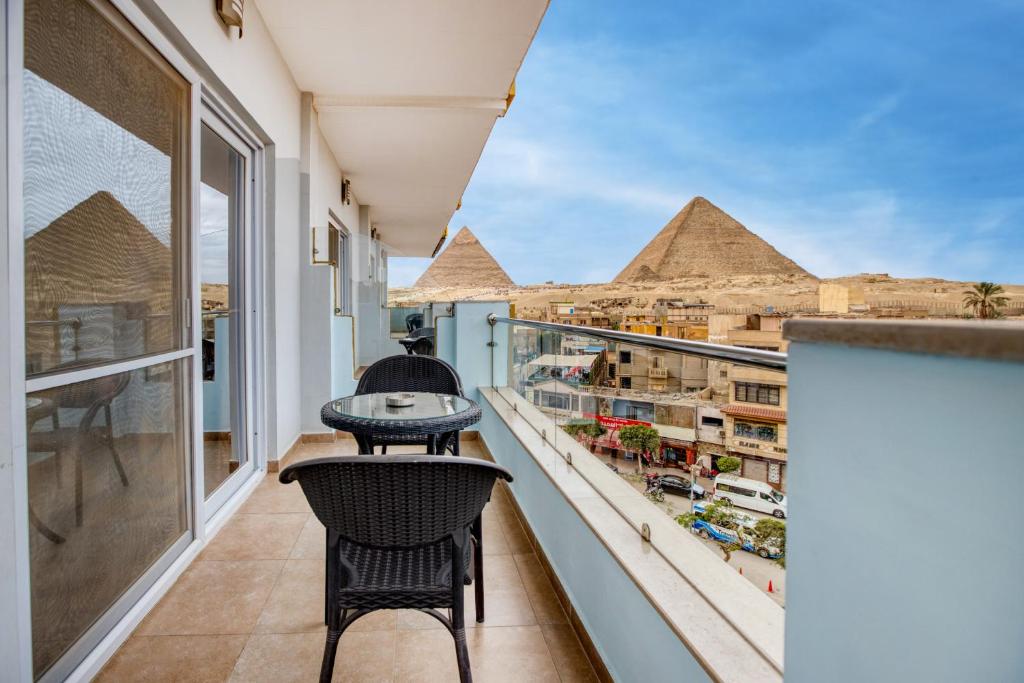
- Giza is the best base for the GEM, the pyramids, and Memphis with Saqqara. You can see the plateau from Pyramids Planet Hotel and Mamlouk Pyramids Hotel.
- Downtown is better for the NMEC (15–25 min by Uber), the Egyptian Museum in Tahrir and the trains from Ramses Station to Alexandria and Luxor. Try Rivera Cairo Hotel or Royal Cairo Hotel.
Still deciding? Our where to stay in Cairo guide compares the neighbourhoods. For more background, see a brief history of Ancient Egypt or how mummification worked.
Sources and how we checked
- Dates and reign: the standard chronology used by most Egyptologists (reign 1279–1213 BC). Older books may give slightly different dates.
- The colossus's moves: National Geographic's report on the January 2018 transfer, plus coverage of the 2006 move from Ramses Square.
- The sarcophagus: the Sorbonne University press release on Frédéric Payraudeau's study, published in Revue d'Égyptologie 73 (2024).
- Abu Simbel's relocation: UNESCO's World Heritage listing for the Nubian Monuments from Abu Simbel to Philae.
- Distances in Cairo: measured by road with the OSRM routing engine on OpenStreetMap data, from the Egyptian Museum in Tahrir to each site (8 October 2026). Real travel times depend heavily on traffic.
- Cover photo: the Great Temple of Ramesses II at Abu Simbel, by Diego Delso, licensed CC BY-SA 4.0, via Wikimedia Commons. We cropped it.
Spotted a mistake? Tell us and we'll fix it.
Frequently asked questions
Where can I see Ramesses II in Cairo?+
In three places. His 11-metre granite colossus stands in the Grand Hall of the Grand Egyptian Museum in Giza. His mummy is in the Royal Mummies Hall of the National Museum of Egyptian Civilization (NMEC) in Fustat, where photos are not allowed. A 10-metre limestone colossus lies in the open-air museum at Memphis (Mit Rahina), about 29 km south of Tahrir by road and 10–15 minutes from Saqqara.
How long did Ramesses II rule, and how old was he when he died?+
About 66 years, from 1279 to 1213 BC in the chronology most Egyptologists use. He came to the throne at about 25 and died at around 90, so most of his subjects had never known another pharaoh. He outlived about a dozen crown princes and was succeeded by his 13th son, Merenptah.
Was Ramesses II the pharaoh of the Exodus?+
There's no evidence for it. The Bible never names the pharaoh of the Exodus. The link comes mainly from a city called Rameses in the Book of Exodus, and from films such as The Ten Commandments (1956) and The Prince of Egypt (1998). Egypt's antiquities authorities have said that no archaeological evidence connects Ramesses II to the Exodus story.
Did Ramesses II's mummy really get a passport?+
Probably not. In 1976 the mummy was flown to Paris for treatment against a fungal infection and was received at Le Bourget airport with military honours. The story that Egypt issued it a passport listing his occupation as “King (deceased)” is widely repeated but unsupported. The mummy travelled with a large file of official paperwork, which seems to be where the legend came from.
About the author
Cairo Stay Finder editorial team
An independent, bilingual team that has travelled Cairo many times, speaks Arabic, and visits every place before recommending it. We write each guide ourselves — no machine translation, no AI filler — and update it as the city changes.
More about how we work